There has never been a neighborhood like it. At its peak in the early twentieth century, the Lower East Side of Manhattan was home to more than 700 people per acre — the most densely populated place in the history of human civilization. Hundreds of thousands of Jewish immigrants, packed into tenements that were never meant to hold them, living five and six families to a floor, sharing a single toilet in the hallway, working sixteen-hour days in the garment factories and the sweatshops.
And yet — from this poverty, from this overcrowding, from this grinding daily struggle — came something extraordinary. Came writers and artists and musicians and scientists. Came politicians and lawyers and doctors. Came the garment workers' unions that changed the face of American labor. And came boxers. Champions. Men who took the fire of the street and the hunger of the tenement and turned it into something that the whole world had to pay attention to.
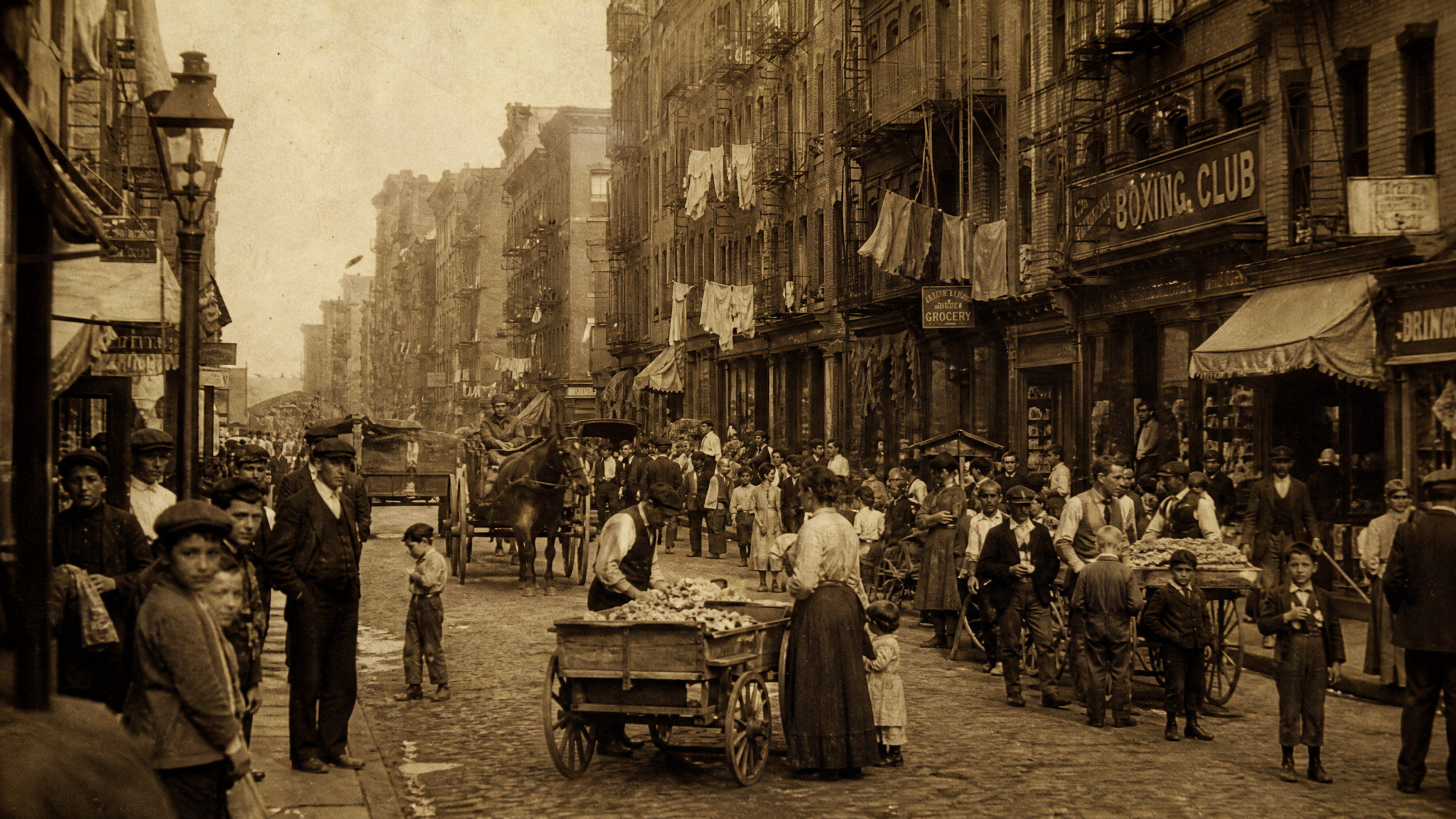
Hester Street, Lower East Side — circa 1920
The World Within a World
The Lower East Side was a world unto itself. Its streets — Orchard, Hester, Delancey, Rivington, Essex — were a cacophony of languages, smells, and sounds. Pushcart vendors selling pickles and herring. The clatter of sewing machines from open windows. Children playing in the streets because there was no room in the apartments. The smell of challah from the bakeries on Friday afternoon.
It was also a world of violence and hardship. Street gangs controlled the blocks. The police were not always friends. Discrimination was open and unapologetic. A Jewish boy walking through the wrong neighborhood could expect to be beaten simply for being Jewish. This was the reality that produced the fighters.
The boxing gym — usually a single room above a saloon or a delicatessen, with a ring, some bags, and a trainer who had seen everything — was the neighborhood's university. It was where boys became men, where raw aggression became skill, where the anger of the ghetto became the discipline of the champion.
The Gyms of the Lower East Side
The gyms of the Lower East Side were not fancy. They were cold in the winter and suffocating in the summer. The equipment was worn. The floors were bare wood, stained with sweat and blood. But they were alive. They were full of boys who wanted something better, who were willing to work for it, who understood that the ring was their way out.
The Stillman's Gym Model
The great gyms of New York — Stillman's on Eighth Avenue, the Pioneer Gym, the Gramercy Gym — were democratic institutions. You paid your dues, you worked hard, and you were welcome. No questions asked about where you came from.
The Trainers
Ray Arcel, Whitey Bimstein, Freddie Brown — the great Jewish trainers of New York shaped champions across every ethnic community. They were the men in the corner, the men who believed in you when no one else did.
The Community
The boxing gym was a community institution. Fathers brought their sons. Brothers trained together. The gym was a place of belonging in a city that did not always make immigrants feel they belonged.
The Fights
The fights were held at Madison Square Garden, at Yankee Stadium, at the local clubs and armories. They were the great public spectacle of the era — the place where the immigrant community came together to watch their own compete on the biggest stage in the world.
The Streets That Made Champions
Orchard Street
The heart of the Jewish Lower East Side. Pushcart markets, garment shops, the smell of pickles and herring. The street where Benny Leonard grew up, where a boy could walk from his tenement to the gym in five minutes.
Delancey Street
The main artery of the neighborhood. The Williamsburg Bridge at one end, the markets at the other. Where the Jewish community came to shop, to argue, to live. Where the fight posters went up on the walls.
Hester Street
The street that Jacob Riis photographed, that became the symbol of immigrant New York. Crowded, loud, alive. The street where children played in the gutters and dreamed of something better.
Essex Street
The Essex Street Market, the synagogues, the settlement houses. Where the community organized, where the unions were born, where the next generation of Americans was being forged.
Rivington Street
The tenements, the sweatshops, the bakeries. Where families of eight lived in three rooms. Where the hunger that drove men into the ring was most keenly felt.
The Bowery
The border between the Jewish Lower East Side and the rest of the city. The saloons, the boxing clubs, the music halls. Where the neighborhood met the world.
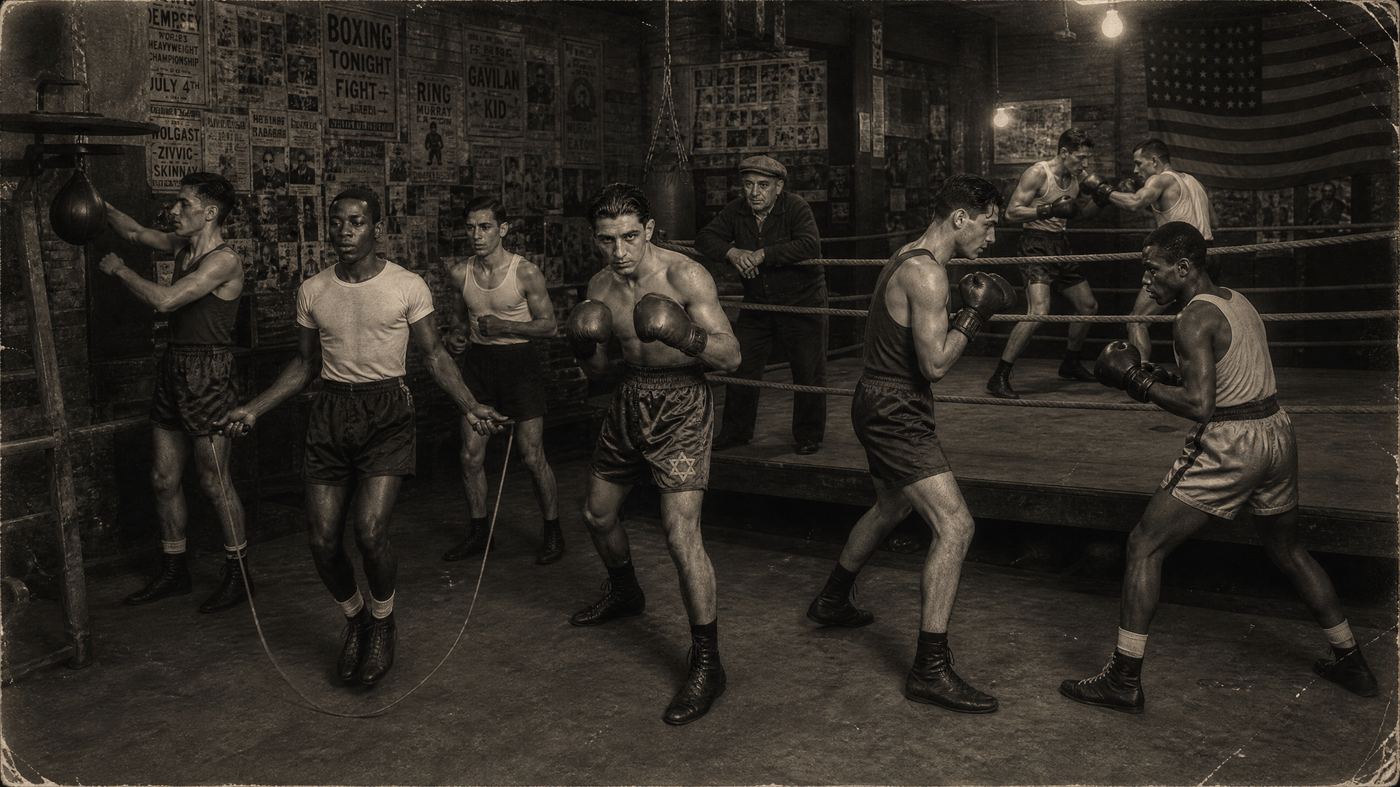
A Lower East Side boxing gym, circa 1934 — Jewish, Italian, Irish, and Black fighters training together
What the Neighborhood Gave the World
The Lower East Side of the early twentieth century gave America more than boxing champions. It gave America the garment workers' unions that established the forty-hour work week. It gave America the Yiddish theater that became the foundation of Broadway. It gave America scientists, artists, writers, politicians, and judges who shaped the nation.
But the boxing champions hold a special place in this story. Because they were the most visible proof — the most undeniable, public, physical proof — that the sons of immigrants could compete with anyone, could beat anyone, could stand in the center of the ring at Madison Square Garden and be the best in the world.
When Benny Leonard walked into a ring with the Star of David on his trunks, every Jewish family on the Lower East Side felt it. When Barney Ross defeated the "Jew-Beater" McLarnin, every Jewish man and woman in America felt it. These fighters were not just athletes. They were proof of something. They were proof that America was real.
"The Lower East Side was the most densely populated neighborhood in the history of the world. And it produced more boxing champions per square mile than any place on earth. That is not a coincidence. That is New York."