The great Jewish fighters of the Lower East Side are gone now. Benny Leonard died in the ring in 1947. Barney Ross died in 1967. Maxie Rosenbloom in 1976. The gyms where they trained have been replaced by condominiums and coffee shops. The tenements where they grew up have been renovated beyond recognition. The world they knew has vanished.
But what they built has not vanished. The legacy of the Jewish fighters of New York is not just a story about boxing. It is a story about what happens when a community refuses to be defined by its suffering. When a people who have been persecuted for centuries decide that they will not be victims — that they will stand up, that they will fight back, that they will prove themselves on the biggest stage in the world.
That legacy lives in every boxing gym in New York City today. It lives in every kid who walks through the door with nothing but hunger and determination. It lives in the idea that the ring is a democracy — that in here, the only thing that matters is how hard you work.
Ray Arcel — The Greatest Trainer
Ray Arcel (1899–1994) was the greatest trainer in the history of boxing. Born in Terre Haute, Indiana, to Jewish immigrant parents, he began his career in the 1920s and worked with more world champions than any trainer before or since. His list of fighters reads like a Hall of Fame: Benny Leonard, Barney Ross, Henry Armstrong, Kid Gavilan, Ezzard Charles, Tony Zale, Roberto Duran.
Arcel was not just a trainer — he was a philosopher of the ring. He believed that boxing was, above all, an intellectual exercise. "Boxing is brains over brawn," he said. "I don't care how much ability you got, if you can't think you're just another bum in the park." This philosophy — that intelligence and discipline matter more than raw power — was the philosophy of the Jewish boxing tradition.
Arcel trained fighters from every background — Jewish, Irish, Italian, Black, Hispanic. He did not see color or religion. He saw potential. He saw work ethic. He saw the hunger that drives a man to be the best in the world. And he shaped that hunger into champions.
Ray Arcel's career spanned seven decades. He was still working as a trainer in his eighties. He was inducted into the International Boxing Hall of Fame in 1992. He is the living embodiment of the Jewish boxing tradition — the idea that wisdom and experience, passed from trainer to fighter, from generation to generation, is the most powerful force in the ring.
"Benny Leonard was the best I ever trained. His mental energy surpassed anyone else's." — Ray Arcel
The Men in the Corner
The trainers who built the champions
Whitey Bimstein
The undoubted emperor of all trainers in his era. A Lower East Side boy who became the most respected cornerman in boxing. He worked with champions across every weight class and every ethnic background. His cut work was legendary — he could stop a cut that would have ended another fighter's night.
Freddie Brown
Another great Jewish trainer who worked with champions from the 1940s through the 1970s. Brown was known for his ability to read a fight and make the adjustments that won rounds. He was the kind of trainer who could change a fight with a single instruction between rounds.
Mike Jacobs
The great Jewish promoter who controlled boxing in New York from the early 1930s to 1946. Jacobs built Madison Square Garden into the cathedral of boxing. He promoted Joe Louis, Barney Ross, and dozens of the greatest fighters of the era. A czar of the sport, inducted into the International Boxing Hall of Fame.
The Lesson of the Ring
The Jewish fighters of the Lower East Side taught America something that it needed to learn. They taught it that the immigrant is not a burden — the immigrant is a gift. That the man who comes to this country with nothing, who has survived persecution and poverty and the long journey across the ocean, has something that cannot be bought or inherited: the fire of someone who has nothing to lose and everything to prove.
They taught it that courage is not the absence of fear. Barney Ross was afraid at Guadalcanal. Benny Leonard was afraid every time he stepped into the ring. The courage was in stepping in anyway. In doing what needed to be done, regardless of the cost.
And they taught it that in the ring — as in life — the only thing that matters is how hard you work. Not where you came from. Not what language your parents spoke. Not what God you pray to. How hard you work.
"That is the lesson of the ring. That is the lesson of New York. That is the lesson of America."
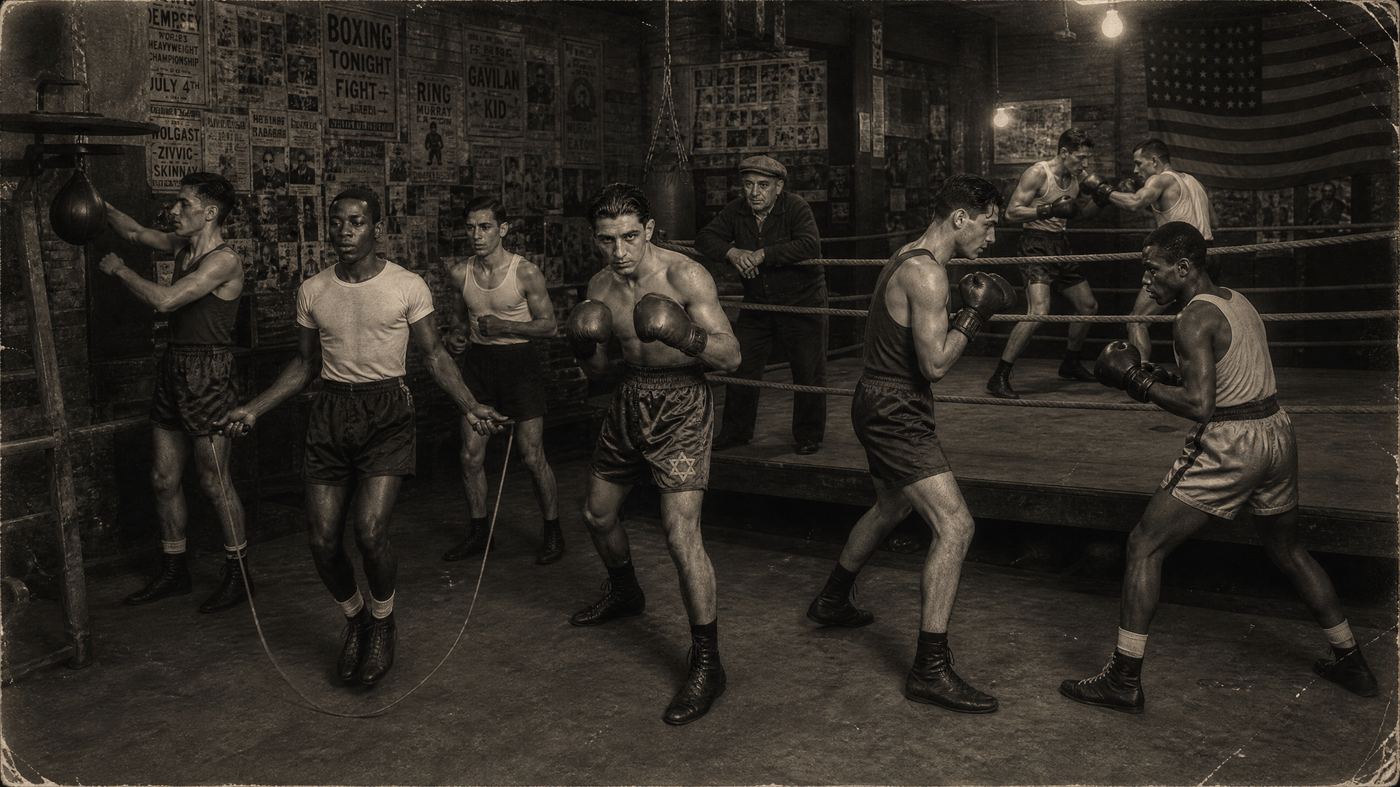
The tradition continues — in every gym in New York City
The Tradition Continues
Today, the boxing gyms of New York City are filled with the sons and daughters of a new generation of immigrants. Dominican, Mexican, Puerto Rican, West Indian, West African, Eastern European. They come to the gym for the same reasons that the Jewish boys of the Lower East Side came to the gym a century ago: because they want something better, because they are willing to work for it, because the ring offers them something that the rest of the world has not yet given them.
And in those gyms, the tradition of the Jewish fighters lives on. Not in the fighters themselves — there are very few Jewish professional boxers today, just as the scholars predicted when the G.I. Bill opened other doors. But in the philosophy. In the idea that intelligence matters as much as power. That discipline matters as much as aggression. That the man in the corner — the trainer, the mentor, the man who believes in you — is as important as the man in the ring.
That is the legacy of Benny Leonard and Barney Ross. That is the legacy of the Lower East Side. That is the legacy of New York.
Trinity Boxing Club — Carrying the Tradition
Trinity Boxing Club, founded by Martin Snow in New York City, carries this tradition into the present. A Brooklyn-born trainer with deep roots in the immigrant story of this city, Snow built Trinity on the same principles that built the great gyms of the Lower East Side: discipline, intelligence, community, and the belief that the ring is a place where anyone — regardless of background — can become a champion.
Trinity's gyms in Manhattan, Brooklyn, and West Hollywood are places where the tradition of the Jewish fighters, the Irish fighters, the Italian fighters, and the Black fighters of New York lives on. Where the lesson of the ring is taught every day. Where the immigrant spirit of New York is honored in every session.
Visit Trinity Boxing ClubDedicated to All Who Fought the Good Fight
To the Jewish fighters of the Lower East Side, who carried the hopes of a people into the ring and never let them down.
To all the immigrants who came to New York City with nothing and built something extraordinary.
To every New Yorker who has ever stood up when it would have been easier to sit down.
NEVER AGAIN • AM YISRAEL CHAI
NEW YORK STANDS TOGETHER